1 / 6
2 / 6
3 / 6
4 / 6
5 / 6
6 / 6

Latest Cannabis News around Asia


For decades, Thailand was one of America’s most resolute allies in the war on drugs. After zero tolerance policies left the Kingdom with the highest rate of incarceration in Asia and a methamphetamine (ya ba) epidemic that not even the most draconian measures could stop, Justice Minister Paiboon Koomchaya shocked the nation in 2016 when he conceded that “the world has lost the war on drugs.” Not only did he suggest legalizing methamphetamine, Koomchaya urged his countrymen to view the drug epidemic through the lens of public health, rather than law enforcement. Today, many hope that this new laissez-faire approach will lead to the legalization of the legendary marijuana that was once among the Kingdom’s most famous and valuable exports.

After the United States built military bases in Thailand during the 1960s and stationed tens of thousands of U.S. soldiers there, the marijuana industry exploded and cheap, powerful pot became as readily available as beer.

“They tie together. Put the stick. Make it nice. Sell for GI easy. One, two, or five for one dollar,” recalled a Thai smuggler who got his start selling pot to U.S. soldiers. “Whatever place GI go, it started whenever they need.”

“With an eighty-cent bottle of gin purchased at the PX,” one Vietnam veteran remembers, “you could trade for a pack of twenty Thai sticks.”
DIPLOMAT BRIEF
WEEKLY NEWSLETTERN


Thai Sticks c. 1974. Photo Michael Ferguson

Enjoying this article? Click here to subscribe for full access. Just $5 a month.

The first Thai marijuana to reach the United States came in the 1960s via the Army Post Office. The difference between Thai marijuana and most Vietnamese and Cambodian cannabis, was the difference between bathtub corn whiskey and single malt scotch. In 1967, one amazed DEA agent to called it “the Cuban cigar of the marijuana world.”

“Who can forget the first strange-looking Thai Sticks a decade ago! Dense, seedless, stronger than a bull elephant. Years before sophisticated sinsemilla techniques were incorporated into the crop management of U.S. growers,” wrote High Times magazine, the journal of record for pot connoisseurs, “the Thais were, without effort, turning out a superior product.” What sold for $3 per kilo at the farm in Isan, easily fetched $4,000 a kilo in any city in the United States in the early 1970s.

The foreign demand for marijuana produced a boom in Thailand’s poorest region during the 1970s and 80s. North of Udorn on the banks of the Mekong sits Isan, a plateau as large as many American states (62,000 square miles) that floods during monsoon season and is arid and dusty during the dry season. Although rice fields are hard to irrigate and do not yield much, marijuana thrives thanks to the Mekong River, whose tributaries replenish the region with rich, silty soil. Farmers in Northeast Thailand take the same care with their cannabis plants that French vintners take with their grapevines.ADVERTISEMENT


“They know how to grow so nice, I mean how to take care of the flower, how to take out the male plant,” said one retired Thai marijuana broker. After they harvested and dried the cannabis sativa flowers (buds), the farmers and their families neatly and uniformly tied them to small bamboo sticks and secured them with threads of hemp fiber.

What made the criminalization of marijuana particularly difficult, not just in Thailand, but certain parts of Southeast Asia, was that it was considered little more than a medicinal or cooking herb with little or no local legal or moral stigma attached. The plant had grown in Thailand, Laos, Cambodia, and Vietnam for centuries and various preparations were used to treat: migraine headaches, cholera, malaria, dysentery, asthma, digestion, parasites, and post-childbirth pain.

“Almost every corner, every house, they have it in the yard growing. The older people, they will like it. The working heavy guy, he will like it,” said one retired Thai grower, “but they use for medicine also, when you really feel fever. So if you have nothing there, you can get like one branch, and ground it up.”

Under Thailand’s 1934 Marijuana Act, penalties for any amount of the plant could not exceed one year in prison. When criticized by American officials for tolerating cannabis, Thailand leaders were quick to remind them that drug abuse was not part of their culture.

“The United States has been able to send men to the Moon. It has built sophisticated weapons for its own defense. Why can’t it do anything effective about narcotics getting to its shores,” Prime Minister Kriangsak Chamanan said in 1977. He reminded the Americans of the rules of capitalism, “Where there are markets, there is bound to be trade, either legal or illegal.” This point was echoed by Alfred McCoy, in his magisterial study, The Politics of Heroin in Southeast Asia, “Driven by myopic moralism, U.S. policy ignores the fundamental dynamics of the drug trade. Over the past two centuries, narcotics have become the major global commodities that operate on fluid laws of supply and demand not susceptible to simple repression.”


During the 1980s, the U.S. government was able to convince and coerce Thailand to partner with them in a war against marijuana. In 1988 alone, the U.S. Coast Guard intercepted eight “motherships” that carried 463,000 pounds of Southeast Asian marijuana bound for American shores. However, in the end, the “victory” was Pyrrhic because Thai drug users replaced cannabis with methamphetamine that is today responsible for 90 percent of that nation’s drug arrests.

Recently, there have been signs that the Thai government is softening its stance on marijuana. A research team at Rangsit University received permission from Thailand’s Narcotics Control Board and made a cannabis extract spray for cancer patients. In April, Dr. Arthit Uraitat, the rector of Rangsit University, called on Thailand’s military leaders to legalize medical marijuana.

“Be brave. Let us use medical marijuana legally regardless of the method,” he said in a press conference, “Those who have cancer, they cannot wait. They need the help now, so I think we need to take every shortcut possible.”

Last week, a private company called the Thai Cannabis Corporation announced the start of a five-year cannabis project that will cultivate 5,000 hectares (12,355 acres) of the plant in the next five years. The Royal Project Foundation will oversee this effort and Maejo University will provide research support. Thai Cannabis Corporation’s objective is to establish a low-cost model to grow, harvest, and process cannabis plants into oils and extracts. Initially, they will focus on breeding high CBD (cannabidiol) cannabis strains that contain minimal amounts of THC (tetrahydrocannabinol) in order to comply with the laws of Thailand. “The mission of the Royal Project Foundation is to research and develop appropriate technology to sustainably improve the quality of life for Thailand’s highland communities. I quite agree with the Thai Cannabis Project,” said the director of the Royal Project Foundation Dr. Vijit Thanormthin.


The Royal Project Foundation was established and funded by King Bhumibol Adulyadej in 1969. An early advocate of sustainable farming, the king sought to improve the quality of life of Thailand’s hill tribes by replacing opium with other crops and also revitalizing Thailand’s forests and safeguarding their water resources for future generations. Cannabis fits very neatly into the Royal Project Foundation’s mandate given that Thailand’s hill tribes were once the world’s premier marijuana growers. The nation is already exporting packaged food, beverages, essential oils, pharmaceuticals, medical devices, and cosmetics. Why not marijuana?

While the Thai Cannabis Corporation hopes to include the marijuana that Thailand was once world famous for in their product line, they will only go as rapidly as the law and Thai government will allow. “The mission of the Thai Cannabis Corporation,” said CEO Timothy Luton, “is to provide an excellent return to shareholders by partnering with Thailand’s farmers and scientific researchers to make, at high volumes and affordable prices, cannabis products that are above reproach.”

Thailand’s slow shift towards marijuana legalization stands in stark contrast to America’s anarchic “Green Rush,” the greatest exhibition of human greed since gold was discovered in California in 1849. Unlike Vietnam, Cambodia, and Laos, a foreign army has never occupied Thailand and they have staved off foreign invaders for centuries. Generations of Western businessmen have been baffled by their unique and refined Buddhist sensibility that often seems to value mental equilibrium and social grace as much as profit.

However, behind the smile and behind the wai are some of the toughest people on earth. Rapacious western marijuana speculators looking to get rich quick would be wise to heed the words of Townsend Harris, the American envoy to Siam (Thailand), who wrote in 1856: “It is an old saying here [in Bangkok] that those who come here for business should bring one ship loaded with patience, another loaded with presents, and a third ship for carrying away the cargo.”
Thailand cannabis: From a war on drugs to weed curries

Thailand cannabis: From a war on drugs to weed

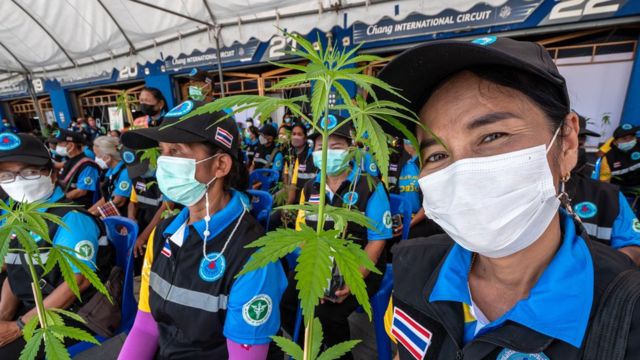
A Thai woman with a cannabis plant
Image caption, 

Thailand has given away one million cannabis plants to encourage cultivation

Thailand legalised cultivating and consuming cannabis this month, reversing a hard-line approach of long prison sentences or even the death penalty for drug offences. The BBC's South East Asia correspondent Jonathan Head reports on what's behind the dramatic change. 

Twenty-one years ago, I had one of the more searing experiences of my journalistic career. We were invited to watch, and film, the execution of five prisoners, four of them convicted drug traffickers, by firing squad in Bangkok's Bangkwan prison. 

The look on those men's faces, as they were walked, leg-chains clinking, to the pavilion where the executions took place, is something I shall never forget. 

Other countries in the region have followed the same punitive approach, notably the Philippines after President Rodrigo Duterte took office in 2016. Singapore and Malaysia have imposed the death penalty for drug trafficking for decades. Tourists coming to South East Asia have long been warned of the harsh penalties they face if caught with even small amounts of marijuana.

It's hard to imagine, then, that what we have seen over the past weeks is actually happening in Thailand.

Cafés and stalls have been openly selling all kinds of cannabis products, or showing off jars filled with potent marijuana flowers. The minister for public health, Anutin Charnvirakul - architect of the new law, which now gives Thailand perhaps the most liberal marijuana regime anywhere in the world - was seen sampling weed-laced curries, and being applauded by farmers who hope it will bring them new sources of income. 

There were gaggles of giggling Thai grannies trying lurid-green cannabis drinks, and lining up to collect one of the million free marijuana plants the government is handing out. 

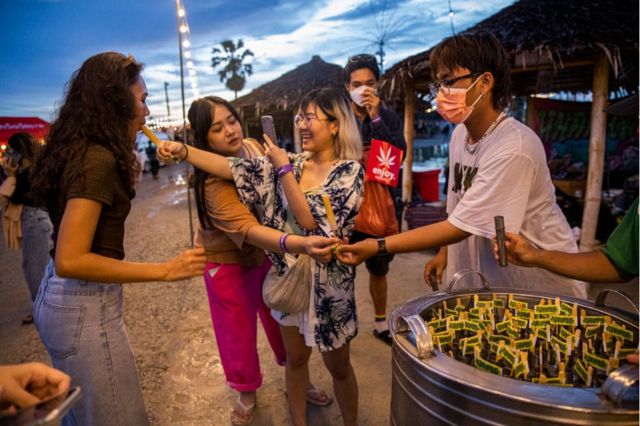
Thai people buy cannabis popsicles at a marijuana legalization festival on June 11, 2022 in Nakhon Pathom, Thailand.

IMAGE SOURCE, GETTY IMAGES

Image caption, 

A festival celebrating the new law offered people weed-laced popsicles

The new law appears to give Thailand what is perhaps the most liberal approach to marijuana anywhere in the world. For the moment, people can grow and consume as much of the plant as they like, though there are a few limits on how they can market and sell it.

"One thing is clear. You cannot go to jail in Thailand just for using cannabis any more," says Tom Kruesopon, a pioneering entrepreneur who helped persuade the government to change its approach. "You can go to jail for doing other things, like smoking in public, as a public nuisance, or creating and selling a product from cannabis that you did not get approval for from the Food and Drug Administration. But Thailand is the first country in the world where you cannot go to jail for growing or using the plant."

"This is like a dream for us. We never thought we would go this far in Thailand," says Rattapon Sanrak, who began campaigning for legalisation of marijuana after experiencing its medical benefits while studying in the United States. 

Two grandparents, his father and then his mother died from cancer. On rushing back from the US to care for his mother, he tried, and failed, to persuade her to use cannabis products to ease her pain, and found it difficult to get access to what were then illegal substances.

What explains this dramatic turnaround in a country still led by conservative military men who seem unlikely drug law liberalisers?

Part of the reason is politics. Mr Anutin adopted the legalisation of marijuana as his party's signature policy in the 2019 election. The party's stronghold is in Thailand's poor, rural north-east, and the policy appealed to farmers struggling to make a living from growing rice and sugar, and in need of a new cash crop. 

So, he was able to tell the cheering crowds, as he announced the new law in his political home base of Buriram earlier this month, that he had delivered what he had promised. He believes in the medical benefits of legalisation, which he hopes will allow poorer Thais to grow their own treatments, rather than having to pay for expensive chemical drugs.

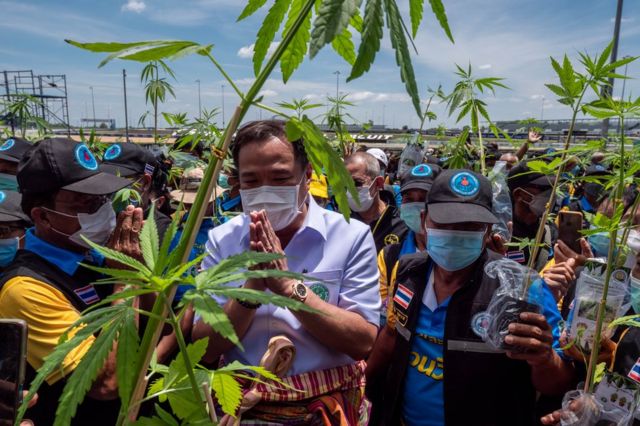
Health Minister Anutin Charnvirakul greeted by supporters clutching donated cannabis plants in Buriram
Image caption, 

Health minister Anutin Charnvirakul has been one of law's biggest supporters

It is also about business. Mr Kruesopon estimates the marijuana business will generate $10bn (£8.1bn) in its first three years, but could earn a lot more from cannabis tourism, where people come to Thailand specifically for therapies and treatments using marijuana extracts. 

He has opened the first clinic in Bangkok that focuses solely on these kinds of treatments. Already some of Thailand's biggest corporations are looking at ways in which they can cash in on the weed bonanza. 

By liberalising the law so quickly and so completely, the government hopes to steal a march on neighbouring countries, many of which may in any case be reluctant to follow the trail blazed by Thailand.

But there is a third factor behind the new marijuana regime - a rethinking of the hard-line approach to drug use, which began seven years ago, surprisingly at a time when Thailand was ruled by a military junta. 

The country has some of the world's most overcrowded prisons, and three-quarters of inmates are there for drug offences, many of them minor. This has not only brought international criticism of the poor conditions in which prisoners have to live, but also cost the government money to sustain them. 

It was a military minister of justice, General Paiboon Kumchaya, who announced in 2016 that the war on drugs had failed, and another, less punitive method of dealing with the use and abuse of narcotics was needed. 

When Mr Anutin presented his marijuana policy, with all its enticing economic benefits, he found he was pushing at a relatively open door - though he says it still took a great deal of pushing to get this far. One other result of the change in the law is that more than 4,000 people on cannabis-related charges are now being freed from jail.

However, the government may not have been prepared for the enthusiastic embrace of cannabis in all its forms seen across Thailand since the new law was passed. 

The plant is showing up everywhere - on ice cream, adorning classic Thai dishes and in new smoothie recipes. Someone is even selling chicken meat from birds which have apparently been fed cannabis. The new law makes pretty much anything related to cannabis legal. 

The government is now drafting additional regulations over its use. Officially its position is that the law only allows cannabis use for medical, not recreational purposes, but it's hard to see how they will enforce that distinction.

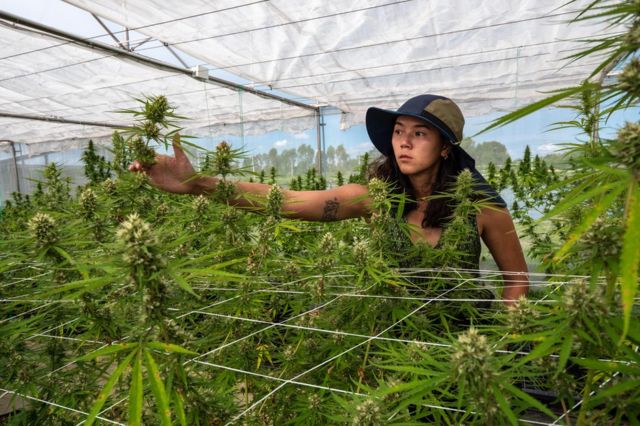
Chidchanok Chidchob tending her marijuana plants in Buriram
Image caption, 

Chidchanok Chidchob tends to her marijuana plants in Buriram

"We all know from studying other markets that recreational use is where the money's at," says Chidchanok Chitchob, a self-styled marijuana enthusiast whose father, a powerful political figure in Buriram, was one of the first to jump on the Thai marijuana bandwagon. "So I think this should be a good step towards that, if we are really thinking of this as an economic crop."

She is experimenting with different strains of the plant to help local farmers cultivate the right kinds for the region.

Mr Kruesopon says he has no issue with further regulation. He advocates sales of marijuana only from licensed vendors, with a prescription, and never to anyone under 18 years old. 

"You don't have to overthink this," he adds. "Whatever you are using for cigarettes, use the same thing for cannabis. There are already laws on the books to help control cigarette use, and alcoholic liquor use - just use the same laws."

This is an uncharacteristically bold step by the Thai government, into a brave new world. The rest of the region will be watching to see if it pays off.

Expat’s Guide to Cannabis in Thailand


An Expat’s Guide to Cannabis in Thailand
2022-06-17
In Thailand, we call marijuana gan-chaa (กัญชา), derived from the original Sanskrit term ganja, a favored synonym for the Devil’s lettuce in many countries around the world and an easy one to remember.

It is hard to believe that as this article in being published, Thailand has had legal weed for exactly eight days and yet there are already a few legal dispensaries open (and selling out of stock), there has already been a major 2-day weed-themed festival, and cafes, restaurants, and bars are already cashing in on the trend by selling THC-laden products along with more innocuous CBD and hemp offerings for various health benefits. Yes, you can get high legally in Thailand now but it is important to know the laws so you do not cross a line that could get you in trouble.

Timeline of Decriminalizing Cannabis in Thailand

Mary Jane was first approved for medical use with a certificate back in 2018 and rumors quickly spread that full decriminalization would soon follow.

On the 8th of May, 2022, in an unprecedented move, Anutin Charnvirakul, Thailand’s minister of health, announced that the government would distribute one million free cannabis plants to Thai citizens. People across the country signed up and received their baby plants to help them begin to grow and cultivate ganja at home for personal use. Finally, on June 9th of 2022, marijuana leaves and flowers (of any potency) were completely removed from the narcotics list.

Another step in the right direction happened almost immediately when Thailand announced they would release prisoners serving time for cannabis related offenses. Prisons were surveyed and viable candidates were elected. At the time of writing, 3,071 men and women were freed from behind bars.

On the 17th of June, 2022, Thailand woke up to the news that a new law was to be passed which requires all companies selling cannabis must have a medical licence. The actual wording of the bill sets the 20-year age minimum for buying cannabis and states it is not for use by or sale to pregnant women. The bit about prescriptions went under under debate, but after a few days of panic, dispensaries went back to business as usual.

In some more surprising news, Airports of Thailand’s Security Department reported that there was no law against people of legal age flying domestically with cannabis. Though, we personally probably won’t be risking that situation any time soon.


At the time of writing, the Cannabis and Hemp Act of Thailand is still in draft form. As Thailand leans into this cash crop and tourism magnet, things can still change and new laws and restrictions might still come into play. Keep up to date on the current situation, that is your responsibility as a visitor in Thailand.
Are You SURE Pot is Legal?

Yes. We are sure. In the beginning, it was thought that there would be a tonne of loopholes for the police to bust you with your doobie. People predicted that the laws would lack transparency, that you would need permission, that it would only include low THC level cannabis-adjacent products. But, when the big day finally came, Thailand was shockingly transparent with the laws and they were far more favorable to stoners than people expected. But there are still limits. Be informed.
Are You SURE these Laws Apply to Expats and Tourists?

Yes. We are sure. You are subject to the exact same laws surrounding marijuana in Thailand as Thai citizens, with the exception of various restrictions about applying for import export licenses (see below). Be warned though, that you can’t just become a weed dealer. The regular laws that apply to your job in relation to the type of visa you hold still apply. If you work in Thailand, you must hold a legal Thai visa and work permit for the job you are doing. Please don’t think you can sling herb on the side of your English teaching gig.
Why The Mixed Messages?

Basically, the international media has gotten a lot wrong about the Thai laws. Many reputable sites have consistently said that the weed we are allowed to buy now is not potent, that it is low in THC and not the primo kush we were hoping for. The reality is that NO new law has yet been written. The only thing that happened is that cannabis was taken off the narcotics list. This means that things are still up in the air as the government eventually pases new bills to regulate its use.
The most relevant law is the law which states what drugs are still “category 5” narcotics according to the Thai Ministry of Health. It is in Thai and the Thai wording is the only legal authority. But the gist of it is that extracts from all parts of cannabis or hemp plants are category 5 narcotic if they contain THC levels over 0.2% by weight.  This means that extracts like oils, tinctures, and resins are totally illegal if they have pretty much any THC in them (remember that high-quality kush these days has up to 20% or even 30% THC).  Non-potent CBD products are acceptable. Products which promote sound sleep and tout pain-relieving qualities are okay, but the law specifies domestic products only, meaning nothing imported is legal at all. Thailand wants the profits that come with legalized ganja to stay in Thailand. Laws About Edibles

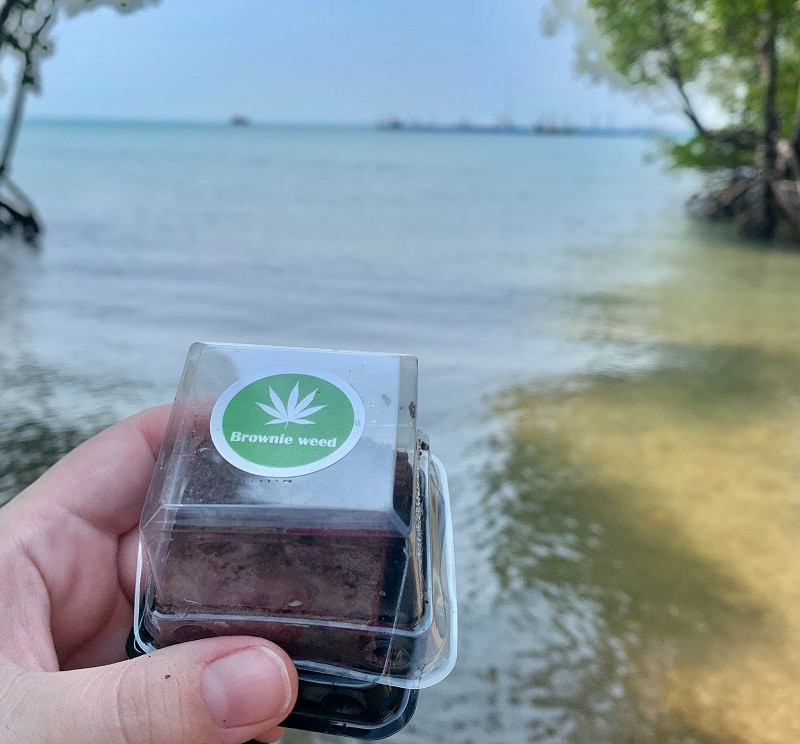
Weed brownie on a Thai beach. But only if the THC is low or you could get into trouble.

People under the age of 20 are not allowed to buy or use it (same as alcohol in Thailand). Officially, extracts are STILL on the narcotics list, so they are still illegal. But weed itself; flowers, leaves, stems, and seeds have no restrictions at all on them. No one is yet regulating weed potency and you can easily buy very strong sticky icky all over the country right now.
Learn The Laws

Don’t just believe us though, read for yourself and stay up to date on the changing situation. Here are the exact words according to Thai law at the time of writing.
Laws About Category V Narcotics

The most relevant law is the law which states what drugs are still “category 5” narcotics according to the Thai Ministry of Health. It is in Thai and the Thai wording is the only legal authority. But the gist of it is that extracts from all parts of cannabis or hemp plants are category 5 narcotic if they contain THC levels over 0.2% by weight.

This means that extracts like oils, tinctures, and resins are totally illegal if they have pretty much any THC in them (remember that high-quality kush these days has up to 20% or even 30% THC).

Non-potent CBD products are acceptable. Products which promote sound sleep and tout pain-relieving qualities are okay, but the law specifies domestic products only, meaning nothing imported is legal at all. Thailand wants the profits that come with legalized ganja to stay in Thailand.
Laws About Edibles

Sadly, the less-than-0.2-percent rule applies to edibles. The process of extracting the THC (tetrahydrocannabinol) cannabinoids from the plant and infusing them into food and beverages qualifies as creating an extract.

This seems to be a contradiction to what people in Thailand are seeing in the market right now. Everywhere you look, shops are popping up specializing in weed snacks, ads on our social media are trying to sell us cannabis candies, even chain restaurants are cashing in, serving ganja on their pizzas! So what is that about?
Two options; most commonly they are selling hemp leaf products which contain little or no THC. These products are often just a gimmick, they won’t get you buzzed, and they have no medical benefit. Sticking a single leaf of a dope plant on a glazed donut is not going to do anything but ruin the taste of the donut.

A second group of entrepreneurs are operating illegally in an area of Thai law that people are still trying to navigate and they are taking a risk in doing so. As Thailand figures out how this whole decriminalized 420 culture is going to play out in the long term, people are risking their livelihoods to meet the demand of their customers. If you purchase these extract products, you are also breaking the law.

Another factor standing in the way of the industry is the FDA in Thailand. The Food and Drug Administration must give approval of any product being consumed and they are not about to start handing out approval for potent weed products. This might change when the laws are more clear in the future, but for now any consumables with THC over 0.2% are illegal.
Laws About Vaping

Also important to note that vaping is illegal in Thailand. And not just for the wacky tobacky. As vaping is a relatively new practice, the law which pertains to e-cigarettes is section 20 of the Customs Act of Thailand. It prohibits the importation of e-cigarettes and vapes, meaning if you are using one, you must have illegally imported it. If you are caught with one, the fine is up to 30,000 Baht and a possible jail sentence of up to 10 years.

Vaping weed will give the police the opportunity to double down on your punishment. Illegal possession of mariguana extracts over 0.2% could be up to 5 years in prison and a fine up to 100,000 Baht. Please obey the Thai laws.
Law Regarding Importation of Marijuana

Section 26 of Chapter 2 of the Thailand Narcotics act of 1979 is still relevant to the importation of marijuana extracts. This law states that no person shall produce, dispose of, import, export or possess narcotics of category IV or category V. Please do not try to bring edibles, oils, or any other cannabis product into Thailand from abroad.

There are certain conditions under which a Thai citizen can request a license to produce, import, export, dispose of, or possess narcotic substances under the category 5 narcotics list. But the licenses are tightly controlled and not a viable option for a foreigner in Thailand.
Laws About Growing Marijuana

Thai authorities are encouraging people to grow their own plants at home, they are even giving them away to Thai citizens. Their official reason for doing this is to encourage people to use their homegrown marijuana for personal use to treat various health conditions. This is the official line, and this is why some people have been suspicious. Some of the things the government representatives have said publicly seem to condemn smoking for fun.
Laws About Smoking Bud

You can smoke weed in private places anywhere in Thailand. This means your home or designated spots like bars and cafes that have made a “private” space for smoking weed. BUT you may not smoke in public places.
The most relevant law is the law which states what drugs are still “category 5” narcotics according to the Thai Ministry of Health. It is in Thai and the Thai wording is the only legal authority. But the gist of it is that extracts from all parts of cannabis or hemp plants are category 5 narcotic if they contain THC levels over 0.2% by weight.  This means that extracts like oils, tinctures, and resins are totally illegal if they have pretty much any THC in them (remember that high-quality kush these days has up to 20% or even 30% THC).  Non-potent CBD products are acceptable. Products which promote sound sleep and tout pain-relieving qualities are okay, but the law specifies domestic products only, meaning nothing imported is legal at all. Thailand wants the profits that come with legalized ganja to stay in Thailand. Laws About Edibles

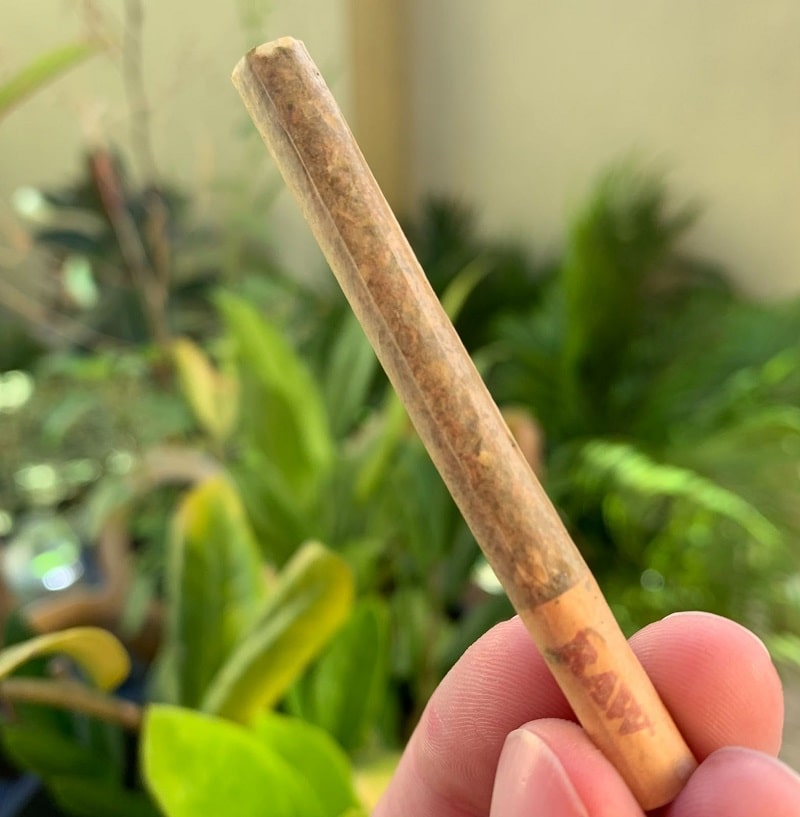
Smoke a perfectly rolled legal doobie in Thailand, but only in private spaces, like your own garden.

While there is no official law about this right now, police are ready to implement the law of public nuisance to clamp down on public blazers. The fine for this crime is up to 25,000 baht and/or three months in jail. Even the famously diligent Thonglor police made a public statement that they would not bother people possessing, buying, or selling weed. Just be cool, man. Smoke inconspicuously.
Laws About Medical Marijuana

The FDA in Thailand approved all hospitals of the Public Health Ministry to prescribe medical marijuana. On top of this, at least 25 specialist cannabis clinics were set up in 2020 to treat people in Thailand. So, if you have one of the approved conditions such as chronic pain, migraines, or insomnia and you talk to your doctor, you could score all kinds of oils and products that are technically not available to the public. Just keep your medical marijuana card on you at all times.
Laws About Driving or Riding Stoned

Common sense should tell us not to go around operating heavy machinery, cars, motorcycles, or anything else while high. But people still do these things, so let us reiterate that just because you are allowed to be high DOES NOT mean that you are allowed to partake in reckless endangerment. Just because the Thai law specifically relating to weed and driving has not been written, does not mean it is legal.

Other laws exist to cover your behavior if you are being irresponsible. Section 43 of the Land Traffic Act of 1979 states that a driver can’t operate a vehicle if they are incompetent to drive or if they drive with carelessness or recklessness. Just don’t imbibe and drive.
The Good Stuff – Where Do We Get It?

Okay, now that you are all brushed up on what you can and can’t do, how do you get your hands on some of that rockin’ reefer?

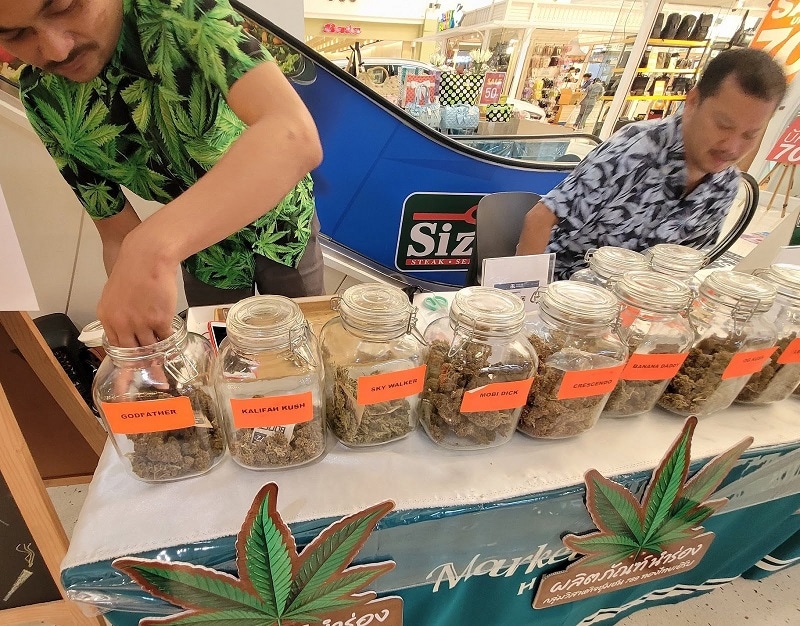
There are new shops popping up every minute in Thailand. There are several major dispensaries in Bangkok and just today there was a pop-up shop in the Market Village Huahin Mall on the ground floor, right there between Stabucks and Auntie Anne’s Pretzels were a dozen huge jars full of dank nuggets being openly sniffed and sold with names like Sky Walker, Godfather, Kalifah Kush, and Mobi Dick.
Here are a few places you can shop in-person for all of your weedy needs: Highland Café is the most prominent spot right now. The folks there are heavily involved in the market and one of the main organizers of the recent cannabis festival near Bangkok. 420 Cannabis Bar has several locationsand some very interesting products. Cannabis fried chicken anyone? The Dispensary by Taratera is the most high-tech (no pun intended) cannabis operation with loads of science behind their goods. Sukhumweed Dispensary got a lot of attention on opening day and sold out to long lines around the block, but we hear they have quickly restocked most products. Leaf Cannabis Cafe has been around for a while selling non-THC products in preparation for the boom. They are now ready to serve more than leafy tea. Chopaka is the brand new space full of fun accessories and bud from Thailand’s queen of Cannabis Kitty Chopaka.

Weed sellers at a pop-up in a Hua Hin mall Thailand six days after decriminalization.

Other than in person shops, there are also a whole bunch of Line and Facebook shops for you to choose from, though we can’t speak to the legalities of these shops, whether they are licenced businesses or just people selling on the side is unknown, but until the laws are rewritten no one seems to care. Everyone is jumping on the bandwagon as fast as they can.
Shops & Dispensaries

Here are a few places you can shop in-person for all of your weedy needs: Highland Café is the most prominent spot right now. The folks there are heavily involved in the market and one of the main organizers of the recent cannabis festival near Bangkok. 420 Cannabis Bar has several locationsand some very interesting products. Cannabis fried chicken anyone? The Dispensary by Taratera is the most high-tech (no pun intended) cannabis operation with loads of science behind their goods. Sukhumweed Dispensary got a lot of attention on opening day and sold out to long lines around the block, but we hear they have quickly restocked most products. Leaf Cannabis Cafe has been around for a while selling non-THC products in preparation for the boom. They are now ready to serve more than leafy tea. Chopaka is the brand new space full of fun accessories and bud from Thailand’s queen of Cannabis Kitty Chopaka.


Sensii is the latest dispensary to pop up in Bangkok, conveniently located inside the Tortilla Quemada restaurant so you can feed your munchies with tacos conveniently.


Candyland is the place to go if you are in Thailand’s coastal playground of Pattaya!
Online Shops

Here are a few options for those lazy days when you need your high delivered: Bloom Asia was one of the first to go public about marijuana in Thailand. They sell a range of THC and CBD products online. Candy After Dark is happy to send their kushy products right to your home with free delivery if you live near Chiang Mai.Line Shopping. If you have a Line account (everyone in Thailand should) then you can simply put key words like “kush” into the search bar and get excited by the amazing selection of choice.


Strains, Varieties, Potency, and Prices

Cannabaceae is the family of plants, then cannabis indica and cannabis sativa are the two main subspecies of plants, hybrid is named as such because it is a new strain created by combining both indica and sativa. These are the three main cannabis strains available in Thailand.

In general indica is said to give a more relaxed and mellow effect, and sativa is said to be more energizing for daytime use with hybrid types being anywhere in the middle.

The thing is, these plants have been subject to so much crossbreeding, cultivation techniques and hybridization that the lines are becoming less clear. Cannabis experts are starting to see no difference between some strains and naming new varieties is becoming a bit of a branding exercise more than anything else.
Here are a few places you can shop in-person for all of your weedy needs: Highland Café is the most prominent spot right now. The folks there are heavily involved in the market and one of the main organizers of the recent cannabis festival near Bangkok. 420 Cannabis Bar has several locationsand some very interesting products. Cannabis fried chicken anyone? The Dispensary by Taratera is the most high-tech (no pun intended) cannabis operation with loads of science behind their goods. Sukhumweed Dispensary got a lot of attention on opening day and sold out to long lines around the block, but we hear they have quickly restocked most products. Leaf Cannabis Cafe has been around for a while selling non-THC products in preparation for the boom. They are now ready to serve more than leafy tea. Chopaka is the brand new space full of fun accessories and bud from Thailand’s queen of Cannabis Kitty Chopaka.   Sensii is the latest dispensary to pop up in Bangkok, conveniently located inside the Tortilla Quemada restaurant so you can feed your munchies with tacos conveniently.   Candyland is the place to go if you are in Thailand’s coastal playground of Pattaya! Online Shops  Here are a few options for those lazy days when you need your high delivered: Bloom Asia was one of the first to go public about marijuana in Thailand. They sell a range of THC and CBD products online. Candy After Dark is happy to send their kushy products right to your home with free delivery if you live near Chiang Mai.Line Shopping. If you have a Line account (everyone in Thailand should) then you can simply put key words like “kush” into the search bar and get excited by the amazing selection of choice.   Strains, Varieties, Potency, and Prices  Cannabaceae is the family of plants, then cannabis indica and cannabis sativa are the two main subspecies of plants, hybrid is named as such because it is a new strain created by combining both indica and sativa. These are the three main cannabis strains available in Thailand.

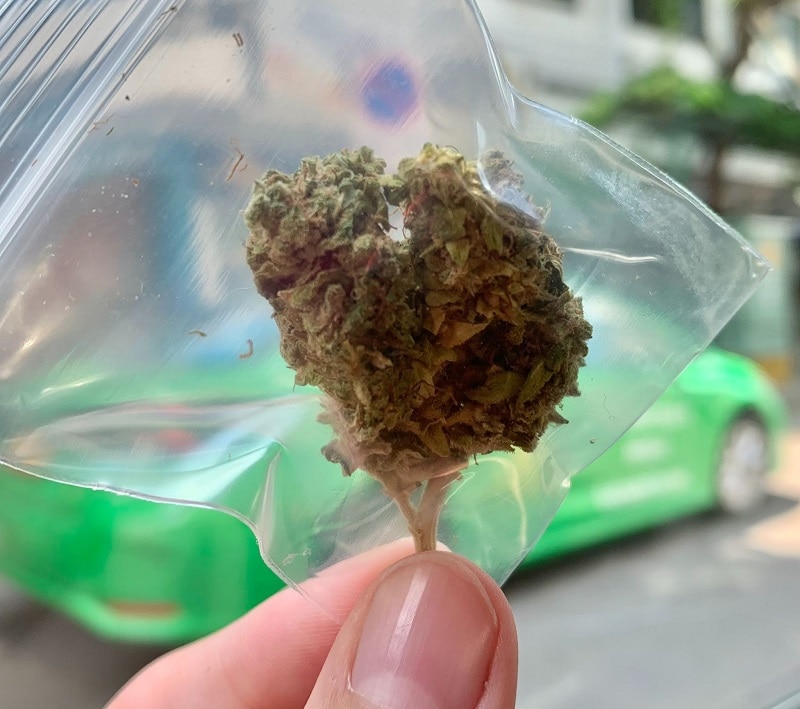
A single gram bud of hybrid called Cherry Bomb bought in Bangkok after decriminalization.

The names of varieties are endless and reading them can sound like the menu for a delicious ice cream shop: Bubblegum, Orange Cream, Cherry Bomb, Girl Scout Cookies, Grape Diamond, Gelato, Truffletini, Mandarin Cookies, Sage n’ Sour, and Strawberry Banana Cream just for a few examples. There are at least 700 of them around the world. Each one has been created to give the user slightly different experiences.

There is no real way to know how weed will affect you, your mood and surroundings as well as what else you have consumed, and even the people near you will affect your experience, someone might feel sleepy on sleepy on sativa, another might feel energized on indica, the best way to figure out what you like is to try a bit for yourself.

In Thailand, quality buds are going for 400 THB to 650 THB per gram on average, and you certainly get what you pay for when it comes to the ganja.
Now, on to You

This is just the beginning for cannabis in Thailand. The news is changing daily, people are very excited and some are getting a bit carried away. When you suddenly remove all restrictions in a country that has had very strict drug laws for an eternity, there is going to be a settling-in phase.

As the first couple of days of decriminalization passed, Thailand saw kids who ate too many edibles freaking out and checking themselves into hospitals, scaremongering began, rumors of immediate restrictions being enforced popped up in the news and were refuted hours later by someone higher up. This is normal, and we will still have to wait and see where Thailand will land when all the new laws are in place.

But for now, as of mid June 2022, you can come to Thailand, blaze up a jazz cigarette, rip bongs, pass the dutch, and enjoy your 420 moment… or should we rephrase “420” to better represent Thailand’s special day? Yes! Henceforth, “96ing” is the new euphemism for the good herb in The Land of Smiles!